As a core component of Alinket’s IoT product portfolio, the Wi-Fi IoT Controller is a fundamental wireless communication module. Its operating mode directly determines how a device connects to the internet and its applicable use cases. Alinket controllers support three primary network modes: SoftAP (Software Access Point), STA (Station), and SoftAP+STA (Hybrid).
The following guide details these modes to help partners quickly implement Alinket Wi-Fi controllers in their specific networking scenarios.
I. SoftAP Mode (Software Access Point Mode)
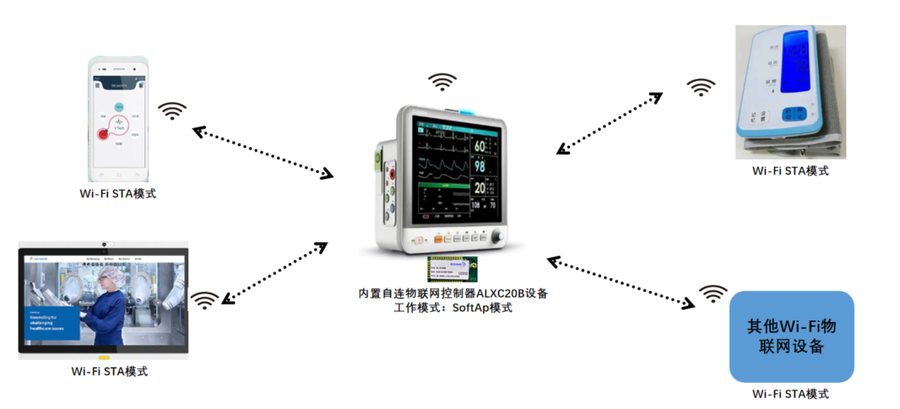
In SoftAP (or AP) mode, the IoT Wi-Fi controller acts as the wireless access point. It serves as the central node of the network, creating an independent local area network (WLAN) and allowing other wireless devices to connect to it.
Working Principles
SSID Broadcasting: The controller continuously broadcasts its SSID (Network Name), allowing other devices to discover and connect.
Automatic IP Assignment: It runs a DHCP server to automatically assign IP addresses to connected devices like smartphones or tablets.
Local Hub: It can host a TCP Server internally, enabling point-to-point communication between devices within the local network (e.g., between a smartphone and multiple IoT devices), achieving true Machine-to-Machine (M2M) connectivity.
Advantages
Convenience: Rapidly establishes network coverage without the need for physical wiring.
High Flexibility: Wireless signal coverage can be adjusted quickly based on site requirements.
Broad Compatibility: Supports various terminals, including smartphones, tablets, PCs, and other IoT devices.
Application Scenarios
Zero-Threshold Provisioning: Users connect to the device's hotspot via smartphone to quickly configure Wi-Fi credentials and server addresses.
Closed Networking: Facilitates collaborative work among multiple IoT devices in remote areas or specific workshops without internet access.
II. STA Mode (Station Mode)
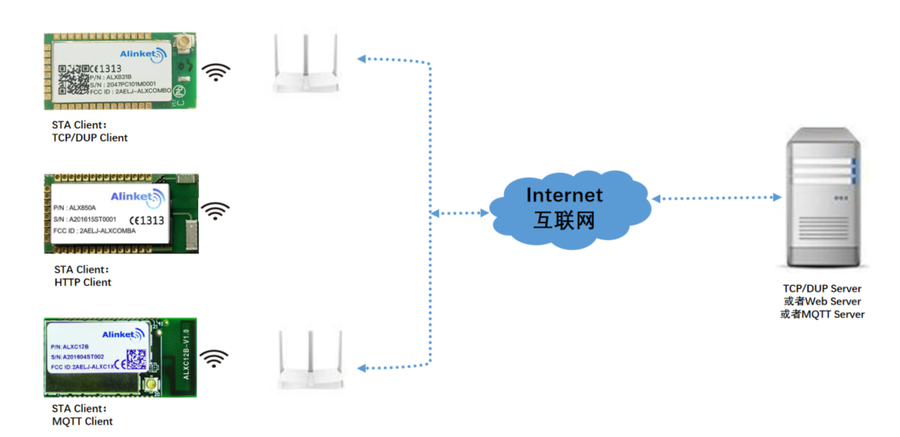
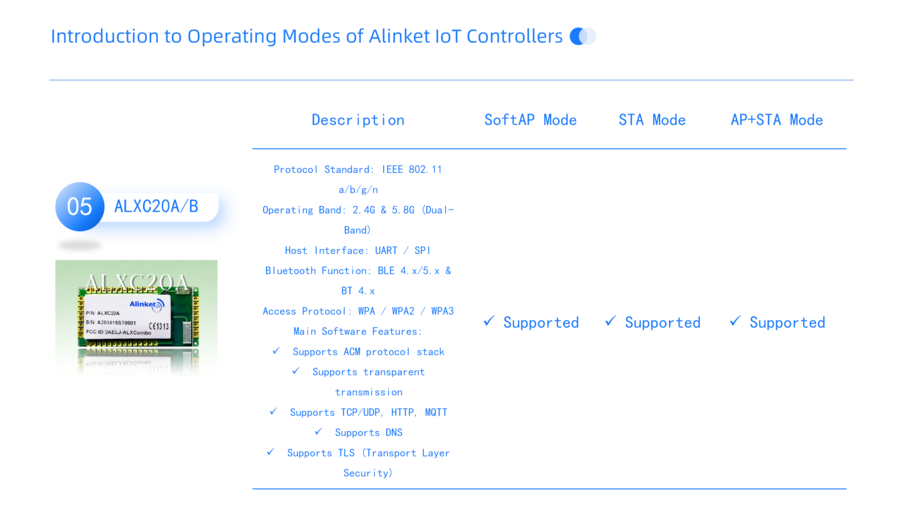
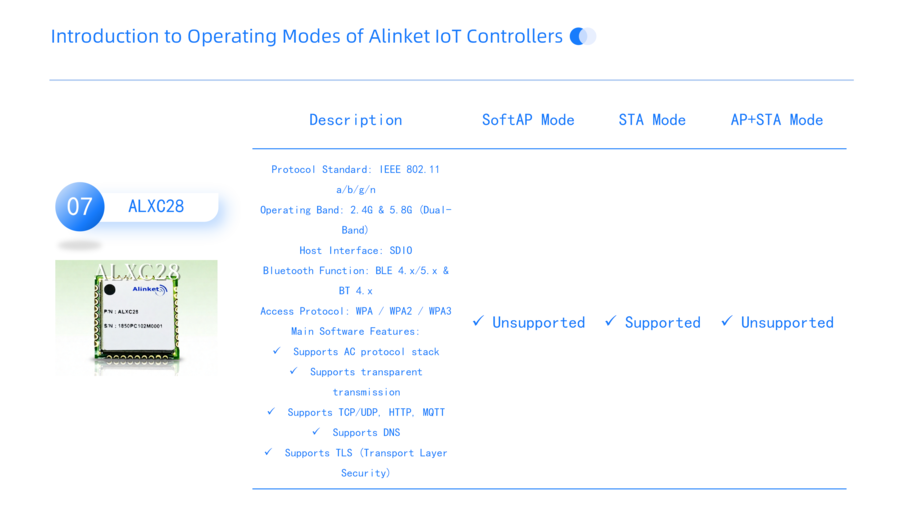
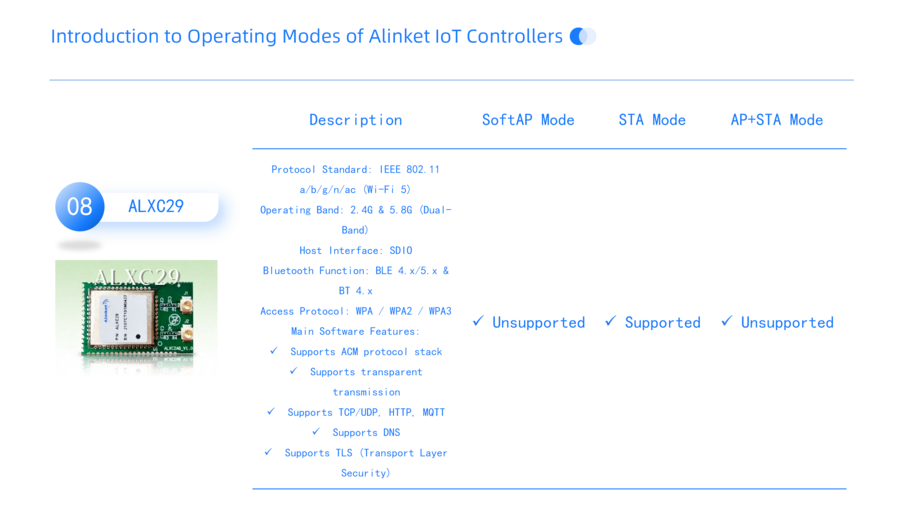
STA mode, also known as Client mode, is supported by all Alinket Wi-Fi controllers. In this mode, the device acts as a terminal that connects to the internet via an external Access Point (AP). It supports WPA/WPA2/WPA3 authentication standards.
Working Principles
Network Access: The STA scans for surrounding AP signals and connects to the target network using WPA/WPA2/WPA3 authentication.
Data Transmission: Once an IP address is obtained, the controller activates its networking protocols (e.g., TCP, UDP, HTTP, MQTT clients) to communicate with the cloud or internet servers.
Auto-Reconnect: If the connection is lost, the STA device automatically attempts to reconnect to the saved AP once the signal is restored.
Optimal Channel Selection: It negotiates with Alinket APs to select the best communication channel.
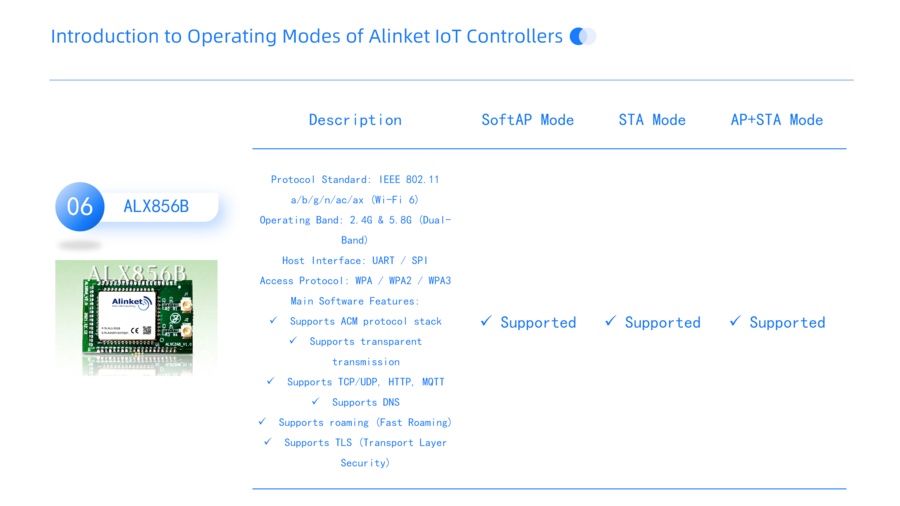
Fast Roaming: Supports seamless switching between routers within 40ms, ensuring upper-layer applications remain online without interruption.
Power-Cycle Recovery: If the device loses power, it will autonomously reconnect to the AP and resume services upon reboot based on the last saved network profile.
Application Scenarios
Smart Medical: Patient monitors, pulse oximeters, and ventilators transmit real-time vital signs to nursing stations via hospital Wi-Fi.
Industrial IoT: Industrial terminals upload operational status and telemetry to ERP/MES systems.
III. SoftAP+STA Hybrid Mode
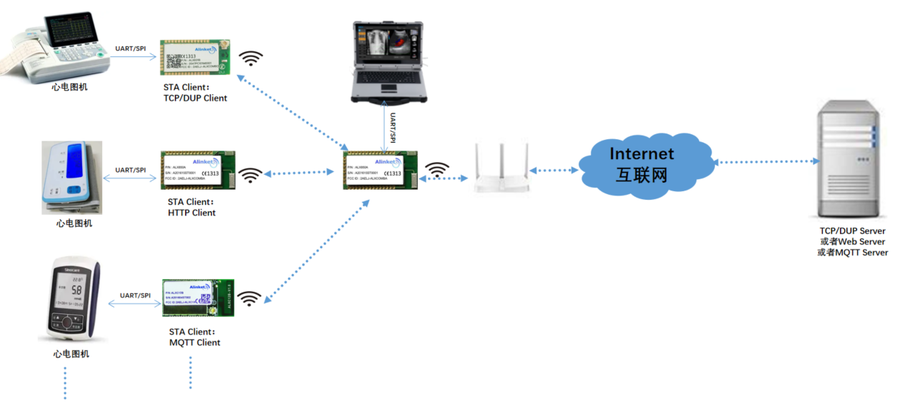
The SoftAP+STA mode allows the IoT device to function simultaneously as an AP and a STA. It acts as both a network creator and a network participant, enabling bidirectional data flow.
Working Principles
Local Network Creation: Creates a local network via SoftAP and assigns internal IPs to sub-devices via a DHCP server.
Upstream Connectivity: Simultaneously connects to an upstream router (STA role) using enterprise-grade authentication to access the internet.
Roaming Extension: Supports roaming for itself and the sub-devices connected to its local network.
Data Aggregation: Uses protocol clients (MQTT, HTTP, etc.) to bridge local device data to cloud servers.
Service Continuity: Supports reconnection and service recovery after power loss or signal drops.
Application Scenarios
Wireless Relay: Extends signal range to eliminate coverage dead zones in large areas.
Gateway Proxy: Acts as a data aggregation point in complex environments, bringing legacy terminals that cannot directly connect to the cloud into the IoT ecosystem.
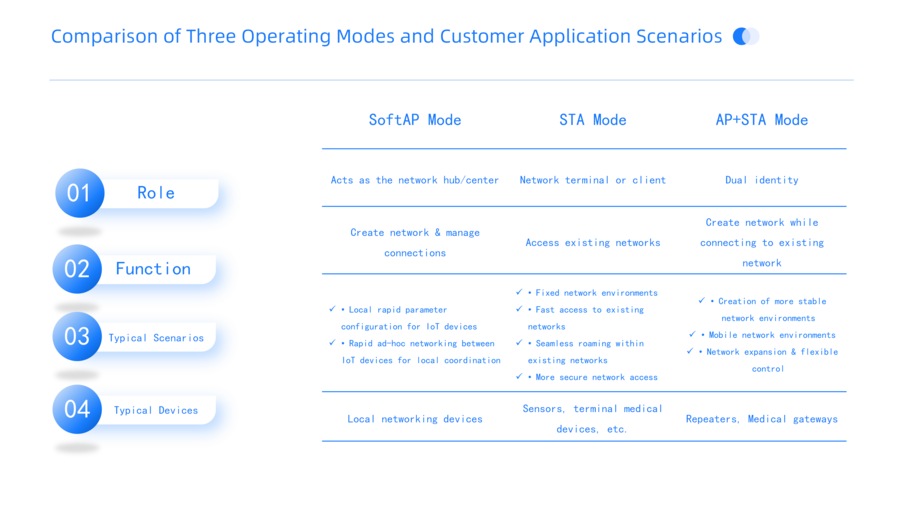
IV. Comparison of Operating Modes
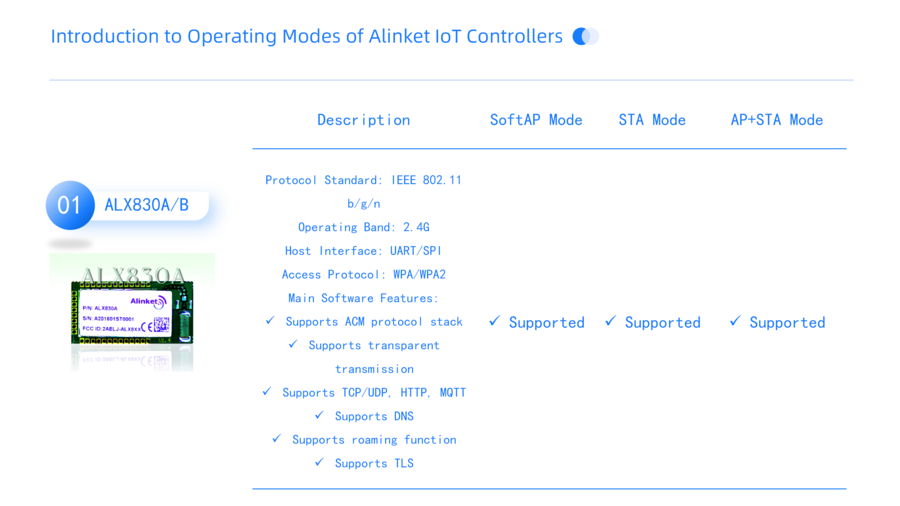
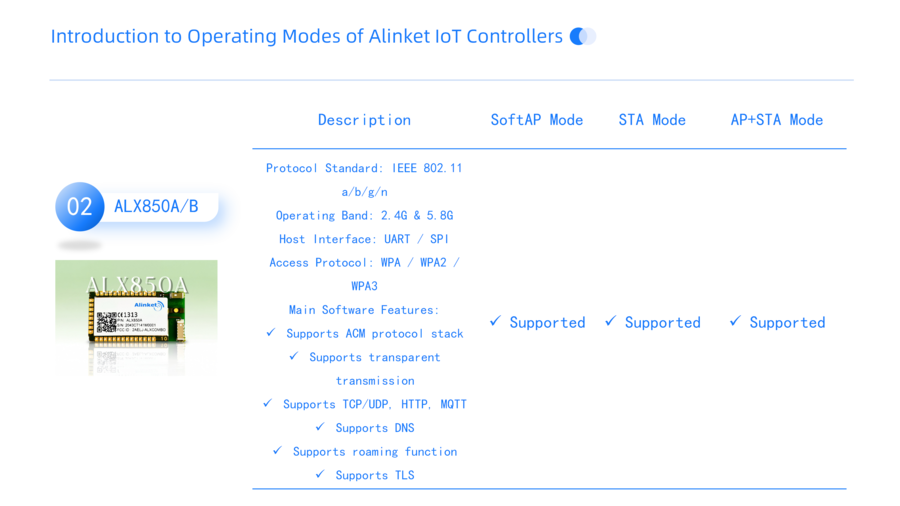
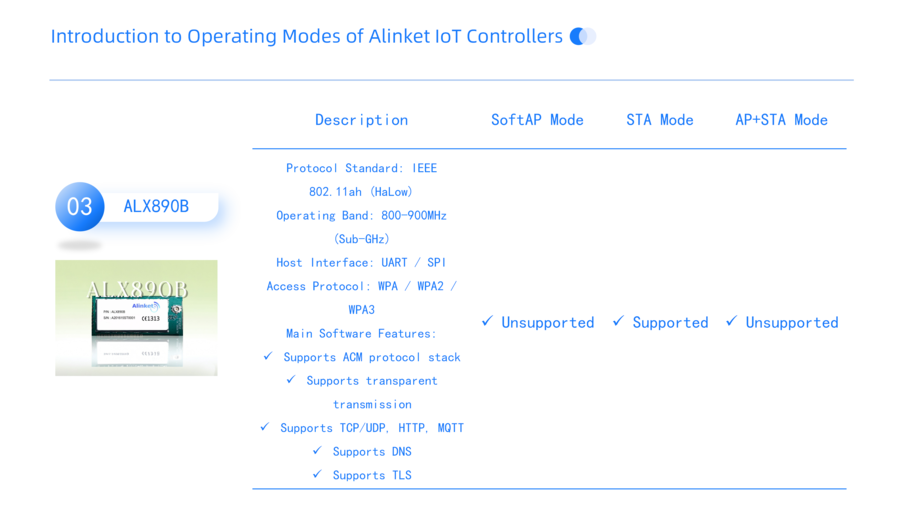
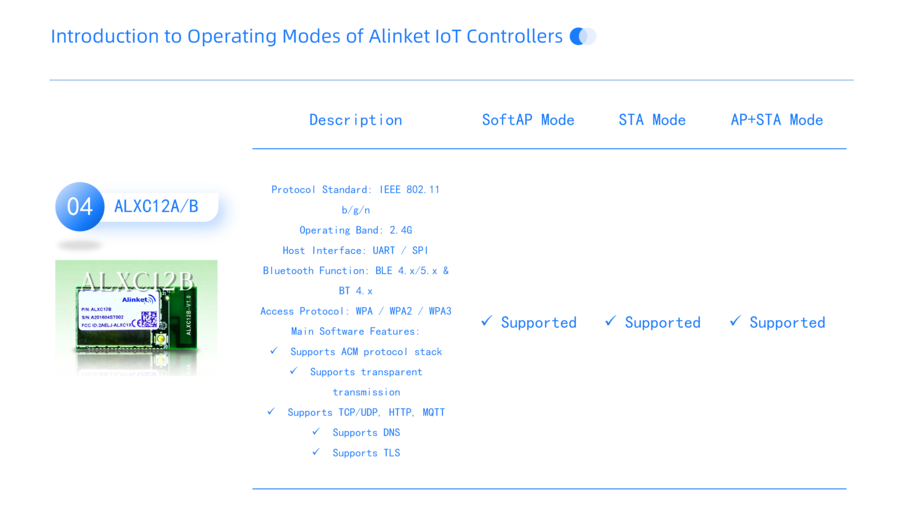
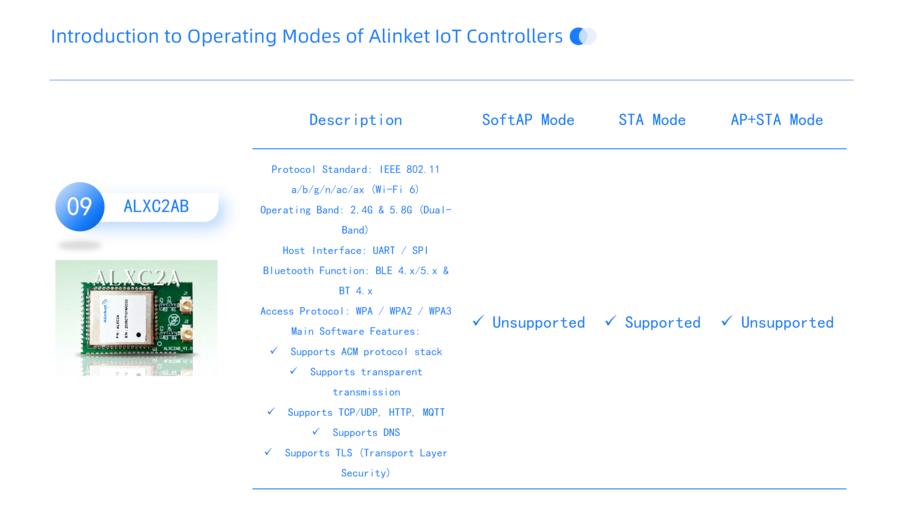
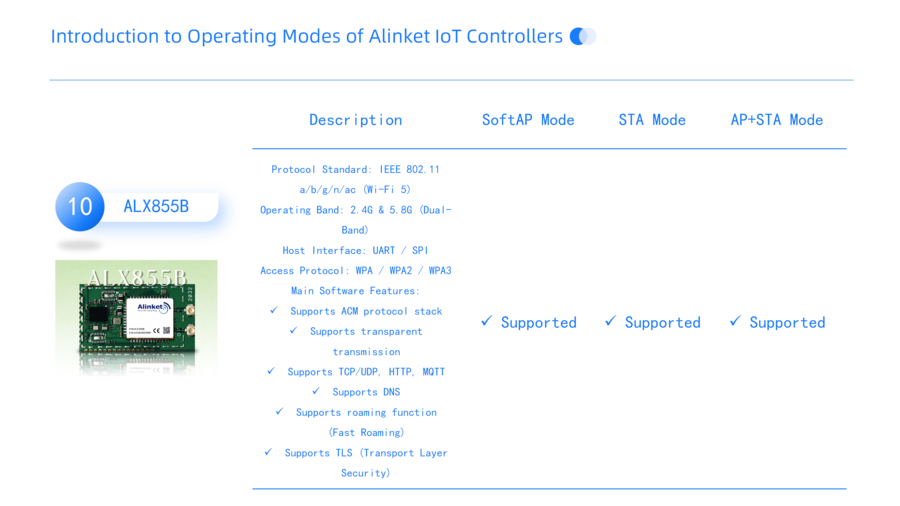
V. Introduction to the Working Mode of the Self-Connecting IoT Controller
Conclusion
As IoT penetrates deeper into vertical fields like healthcare and industry, the demand for Wi-Fi stability, security, and flexibility has never been higher.
By optimizing SoftAP, STA, and Hybrid modes, Alinket Technology does more than just solve connectivity; we address critical pain points through 40ms fast roaming, WPA3 high-level security, and self-healing capabilities. Whether for simple parameter configuration or complex industrial-grade gateway applications, Alinket Wi-Fi controllers provide the robust technical foundation needed to shorten R&D cycles and achieve full-scenario networking.